A Successful Survey Weekend at Hodnet Hall

Wings to the past would like to extend heartfelt thanks to Sir Algernon Heber Percy and Lady Jane for kindly granting permission to carry out our recent geophysical survey within the beautiful grounds of Hodnet Hall, to Hodnet Charities for their generous funding and Dr Martin Huggon of Lincoln Bishop University for their professional services and support, all of which made this important stage of the research possible.
Over the weekend, the team and community volunteers explored the landscape around Hodnet Hall and Gardens seeking to locate the Old Hall and understand the field adjacent to the brook and near to the Motte and Bailey. Surveys were conducted using a combination of Ground Penetrating Radar (GPR), resistivity, and GPS topographical survey techniques. Despite a few technical issues with the GPR equipment that proculded a full survey of the Old Hall site, extensive resistivity work was completed across the field by the brook, an area with potential to to relate to the motte and bailey and were it is believed a medieval and post-medieval mill may have been located. In addition an initial walking survey of the brook was conducted.
Initial findings from the surveys are very promising. A potential feature has been identified where the riverbed of the brook drops to a depth of around two metres, which may be associated with the historic mill’s water system. In addition, a large iron blade was discovered in the brook, possibly a remnant of the mill machinery. The geophysical survey result will take a while to be interpreted and result s should be avaiable to the team in late 2025.
We are delighted to share that Lincoln Bishop University has now offered to double their academic contribution at no cost, as part of their Knowledge Exchange research priorities. This partnership means that the funding kindly provided by Hodnet Charities will go even further, supporting twice the amount of analysis and interpretation and extending the project’s research capacity into 2026.

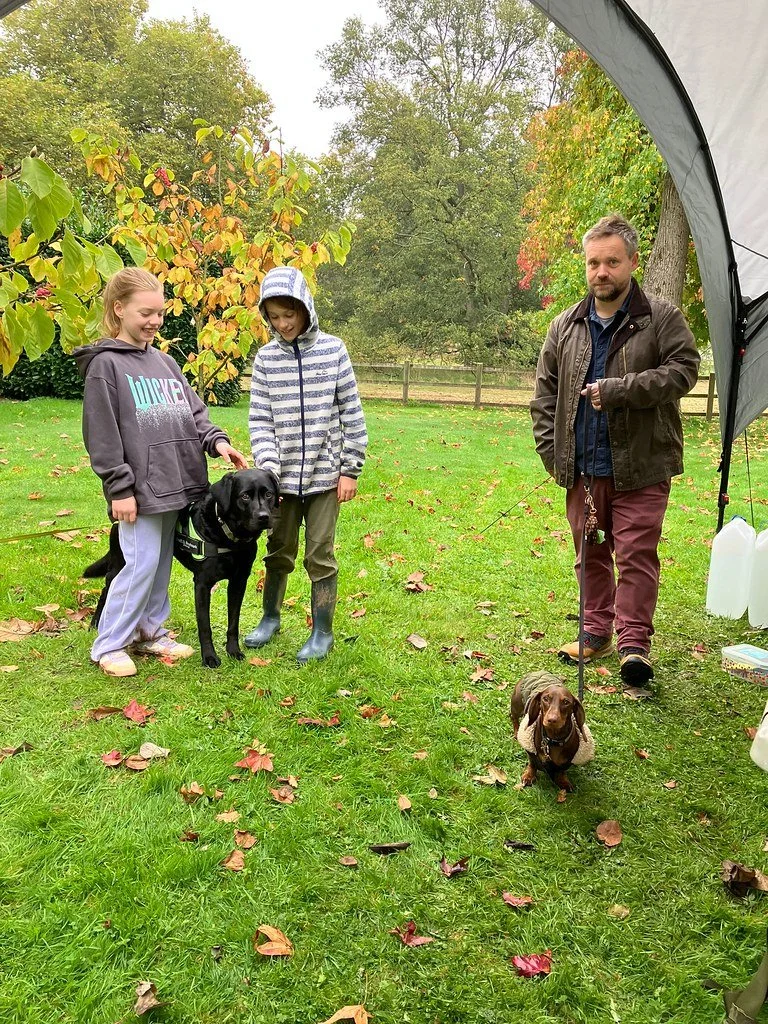
The weekend also brought together members of the local community and military volunteers, with over ten community participants and eight service personnel (and their families) taking part. Visitors to the Hall on teh Sunday enjoyed seeing finds from previous excavations, learning about the survey methods, and watching children take part in a hands-on sand test pit activity.
Feedback from everyone involved was overwhelmingly positive, and the project team is already planning further work for early 2026, expanding the survey to include parts of the village.
We are extremely grateful to everyone who supported the Hodnet Heritage weekend, particularly Sir Heber Percy, Hodnet Charities, Lincoln Bishop University, and all the volunteers who gave their time and enthusiasm to uncover more of Hodnet’s fascinating past.

Archaeological Discoveries: The Results of our 2025 Survey
The October 2025 survey at Hodnet Hall has provided us with some glimpses into the site's hidden history to date. By combining Ground Penetrating Radar (GPR), resistivity, and high-resolution topographical mapping, our team of volunteers and specialists identified several significant archaeological features that have remained unseen for centuries.
Key Findings from the Field
1. Rediscovering the Old Hall (Area 1)
Using GPR, we successfully peered beneath the modern driveway and garden beds to locate the footprint of the timber-framed Old Hall.
We identified a clear linear feature (a1) at a depth of c.0.4m–1m that likely represents a demolished wall foundation or a rubble-filled water channel.
A north-south anomaly (a2) revealed complex signals between 0.5m and 1.5m deep, possibly indicating drains or structural chambers associated with the original hall.
Directly under the modern road, a sub-circular anomaly (a3) appeared at c.1m depth, suggesting the presence of original structural elements or substantial levelling material from the Hall's history.
2. Investigating the Medieval Landscape (Areas 2 & 3)
Our survey extended south toward the motte and bailey castle to search for the site's lost medieval watermill.
In Area 2, we detected a curvilinear anomaly (a6) that may relate to early water management systems near the beck.
Area 3 revealed significant variations in ground resistance, which suggest historical quarrying or landscape remodelling that does not appear on any modern maps. 1
3. Mapping Subtle Earthworks
Our high-resolution topographical survey identified features missed by standard satellite and LiDAR data. We successfully mapped a prominent ridgeline and subtle marks potentially indicating ridge and furrow cultivation, evidence of the medieval farming practices that once sustained the Hodnet estate.
Why These Results Matter
These findings prove that substantial archaeological remains of the Old Hall survive beneath the surface. Furthermore, the anomalies identified around the castle beck provide a roadmap for future investigations into the village’s past.
What’s Next for Hodnet Heritage?
The success of this survey has laid the groundwork for a wider "Hidden History" project. We hope to expand the project into the village core to (all dependant on resources, funding and permissions):
Use small-scale test pits to ground-truth the foundations we’ve identified.
Extend our geophysical search to locate the medieval mill and understand what secrets there are below other parts of the village.
Provide even more opportunities for local volunteers and service personnel to master archaeological techniques.
Undertake community talks about the results and wider project.
Support the future of this project